
Introduction: Embarking on the Data Science Journey
Imagine you’re an aspiring chef, eager to create culinary masterpieces. You have the passion, the recipes, and the vision. But without the right tools—knives, pans, and ingredients—your journey becomes daunting. Similarly, in the realm of data science, Python serves as the versatile kitchen, and its libraries are the essential tools that transform raw data into insightful delicacies.
Python’s simplicity and vast ecosystem make it the go-to language for data scientists worldwide. Whether you’re cleaning data, building predictive models, or visualizing results, Python’s libraries streamline the process, making complex tasks manageable and even enjoyable.
Why Python is the Backbone of Data Science
Before diving into the tools, let’s understand why Python holds a special place in the data science community:
User-Friendly Syntax: Python’s readable code structure allows beginners to grasp concepts quickly.
Extensive Libraries: A rich collection of libraries caters to every data science need, from data manipulation to machine learning.
Community Support: A vast, active community ensures continuous development, support, and resource availability.
Integration Capabilities: Python seamlessly integrates with other languages and tools, enhancing its versatility.
Real-Life Scenario: From Data Chaos to Clarity
Meet Anika, a marketing analyst at a mid-sized e-commerce firm. She faced challenges in understanding customer behavior due to scattered data across platforms. By leveraging Python’s libraries like Pandas for data cleaning and Matplotlib for visualization, Anika transformed chaotic data into clear insights, leading to a 15% increase in customer retention.
Explore more blogs about Python with Data Science.
Essential Python Libraries for Data Science
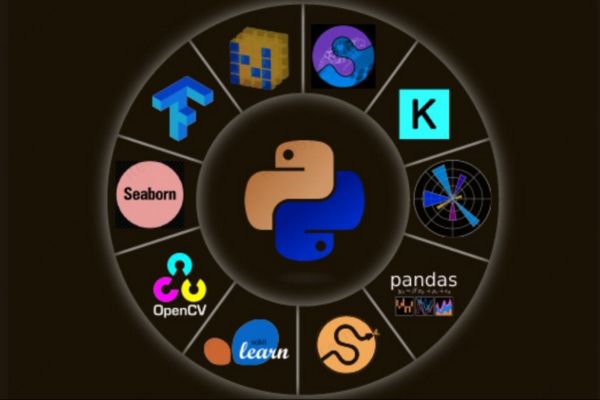
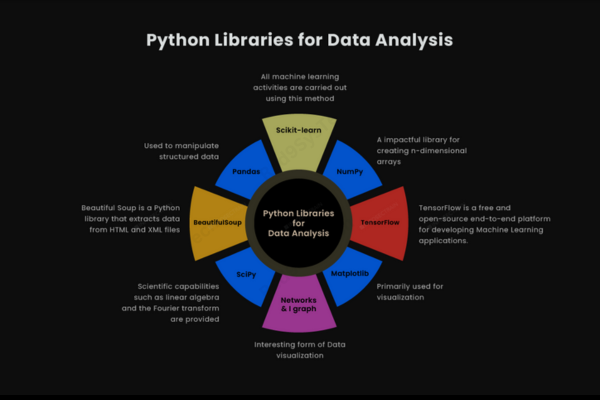
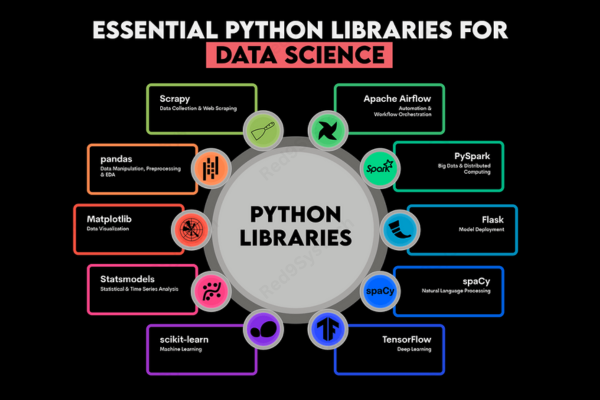
Let’s explore the key libraries that empower data scientists:
1. NumPy: The Numerical Powerhouse
Purpose: Provides support for large, multi-dimensional arrays and matrices.
Use Case: Performing mathematical computations on large datasets efficiently.
Example: Calculating statistical measures like mean and standard deviation.
2. Pandas: Data Manipulation Made Easy
Purpose: Offers data structures and functions for manipulating numerical tables and time series.
Use Case: Cleaning and preparing data for analysis.
Example: Handling missing data, merging datasets, and filtering rows.
3. Matplotlib: Visualizing Data Insights
Purpose: Creates static, animated, and interactive visualizations.
Use Case: Plotting data to identify trends and patterns.
Example: Generating bar charts, histograms, and line graphs.
4. Seaborn: Statistical Data Visualization
Purpose: Builds on Matplotlib to provide a high-level interface for drawing attractive statistical graphics.
Use Case: Visualizing complex datasets with ease.
Example: Creating heatmaps, violin plots, and categorical plots.
5. SciPy: Advanced Scientific Computations
Purpose: Used for scientific and technical computing.
Use Case: Performing tasks like optimization, integration, and interpolation.
Example: Solving differential equations and conducting signal processing.
6. Scikit-learn: Machine Learning Simplified
Purpose: Provides simple and efficient tools for data mining and analysis.
Use Case: Implementing machine learning algorithms.
Example: Building classification, regression, and clustering models.
7. TensorFlow & Keras: Deep Learning Frameworks
Purpose: Facilitates building and training deep learning models.
Use Case: Developing neural networks for tasks like image and speech recognition.
Example: Creating convolutional neural networks for image classification.
8. Jupyter Notebook: Interactive Coding Environment
Purpose: Offers an open-source web application for creating and sharing documents with live code.
Use Case: Documenting the data science process with code, visuals, and narrative.
Example: Combining code execution, text, and visualizations in a single document.
Building a Data Science Project: A Step-by-Step Guide
Data Collection: Gather data from various sources like CSV files, databases, or APIs.
Data Cleaning: Use Pandas to handle missing values, duplicates, and inconsistencies.
Exploratory Data Analysis (EDA): Utilize Matplotlib and Seaborn to visualize data distributions and relationships.
Feature Engineering: Create new features or modify existing ones to improve model performance.
Model Building: Apply Scikit-learn to train and evaluate machine learning models.
Model Deployment: Use frameworks like Flask or Django to deploy models into production environments.
Explore more blogs about Python with Data Science.
Tips for Aspiring Data Scientists
Start Small: Begin with simple projects to build confidence.
Practice Regularly: Consistent practice enhances understanding and retention.
Engage with the Community: Participate in forums, attend workshops, and collaborate on projects.
Stay Updated: The field evolves rapidly; keep learning about new tools and techniques.
Conclusion: Empowering Your Data Science Journey
Embarking on a data science journey can seem overwhelming, but with Python and its robust libraries, the path becomes navigable and exciting. By mastering these tools, you’re not just learning a programming language; you’re unlocking the potential to derive meaningful insights from data, drive informed decisions, and make a tangible impact in any industry.
Explore more blogs about Python with Data Science.