
Spring Framework: A Comprehensive Guide for Java Developers
The Spring Framework is a powerful, lightweight, and open-source framework for building enterprise-level Java applications. It simplifies Java application development by providing dependency injection, transaction management, and MVC architecture.
Discover more at RedSysTech Spring Guide.

What is Spring Framework?
- Spring is an open-source framework for Java-based applications.
- Provides modular and flexible architecture for enterprise applications.
- Used for backend development, microservices, and cloud applications.
- Works with Spring Boot, Spring MVC, and Spring Security to simplify Java development.
Learn more at Spring Framework Official Documentation.
Key Features of Spring Framework
- Inversion of Control (IoC) – Manages object dependencies automatically.
- Aspect-Oriented Programming (AOP) – Separates cross-cutting concerns like logging and security.
- Spring MVC – Framework for building web applications.
- Spring Boot – Simplifies Spring application setup with minimal configuration.
- Spring Data – Integrates with databases using JPA, Hibernate, and NoSQL.
Explore Spring Boot vs Spring Framework.
Spring Framework Architecture
| Component | Description |
|---|---|
| Core Container | Manages beans and dependency injection. |
| Spring AOP | Enables aspect-oriented programming. |
| Spring MVC | Helps develop web applications. |
| Spring Security | Adds authentication and authorization. |
| Spring Data | Provides easy database integration. |
Check out Spring Framework Architecture.
How to Set Up a Spring Project?
1. Install Java & Maven
- Download and install Java JDK from oracle.com.
- Install Maven for project management:
mvn -version
2. Create a Spring Boot Application
spring init --name=spring-demo --dependencies=web,data-jpa,h2 spring-demo
cd spring-demo
mvn spring-boot:run
3. Configure Spring Boot Application
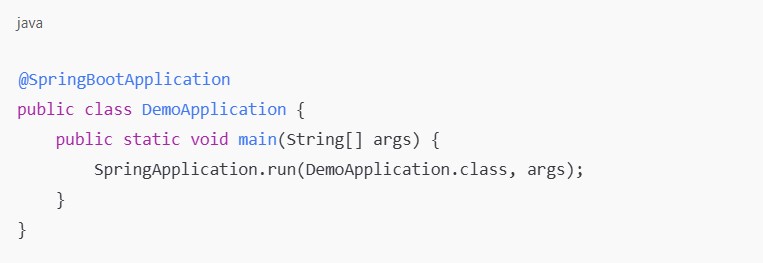
Building a REST API with Spring Boot
1. Create a REST Controller
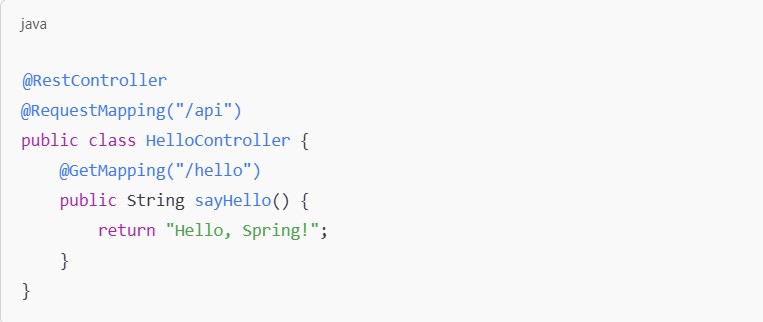
2. Run the Application & Test the API
- Start the server:
mvn spring-boot:run
- Open browser or use Postman:
http://localhost:8080/api/helloExplore Spring Boot REST API Guide.
Spring Boot vs Spring MVC
| Feature | Spring Boot | Spring MVC |
|---|---|---|
| Setup | Minimal configuration | Requires XML/Annotations |
| Speed | Fast | Moderate |
| Microservices Support | Yes | Limited |
| Best For | Quick application setup | Enterprise-level applications |
Spring Boot vs Spring MVC
Career Opportunities for Spring Developers
Java Backend Developer
Build scalable, high-performance Java applications using Spring Boot.Microservices Developer
Design and maintain distributed cloud-based systems powered by Spring.Full-Stack Developer
Combine Spring for robust backend logic with frontend tools like React or Angular.Cloud Engineer
Deploy and manage Spring-based applications across cloud platforms like AWS, Azure, or GCP.
Future of Spring Framework
AI & Machine Learning Integration
Spring is expanding its capabilities by supporting AI-driven applications.Spring Native & GraalVM
Enjoy faster startup times and a smaller memory footprint with native image support.Cloud-Native Development
Expect deeper integration with microservices architecture and Kubernetes environments.Enhanced Security Features
Benefit from improved authentication mechanisms and advanced threat detection.
Read about Spring Framework Roadmap.
Conclusion
As the most popular Java framework for enterprise development, Spring offers a powerful toolkit for building modern applications. It streamlines backend workflows, supports cloud deployment, and excels in microservices architecture. Mastering Spring can lead to high-paying career opportunities in the tech industry.
Start your journey in Spring Framework Today.